I started to get the feeling energy and resource efficiency is a way of life Down Under. While I didn't meet enough Australians to be able to make general claims about their way of life, there were specific examples that exposed me to energy efficiency, waste reduction efforts and recycling availability. The couple we sat next to at the Botanical Gardens for the NYE fireworks mentioned family friends that just live simply and have only the appliances they need. The plugs on the walls oftentimes had little switches where you could turn off the power supply while things were still plugged in. The following pictures and video are some things I came across while traveling throughout the country that pointed towards good stewardship of natural resources.
Energy Star Ratings on appliances
Small washing machine and drying rack
A page from a pamphlet explaining Sydney's Zero Waste goals. Great Resource: http://www.cityofsydney.nsw.gov.au/zerowaste/
2 buttons to choose from! 1 button is a full flush, the other is a half flush
100% Degradable Bag in Cairns
Garbage and Recycling Station at Featherdale Wildlife Park in Sydney
100% Compostable napkin and tray from Pie Face, a popular meat pie cafe in Australia (taken at Sydney Airport)
Sydney Airport food court
Garbage and Recycling at Fitzroy Gardens in Melbourne
Calorie counts were published at all fast food restaurants. This also gives you an idea for how expensive things were. At least to me, Australia was more expensive than the US, and other travelers I talked to had the same impression.
Our guide in the Daintree Rainforest talking about resource and energy efficiency up in the Rainforest! We were riding in the van back from the night walk through the forest, and once he started talking about the rainwater collection, ecotourism, and electricity, I started filming :D
The SWITCH Energy Projectis the "groundbreaking film, video and education program – uniting diverse audiences in a shared understanding of energy and promoting efficiency" spearheaded by a UT Austin Geology professor, Dr. Scott Tinker. For 10 years, he went around the world (to 11 countries to be exact) to answer one simple question: What does our energy future look like?
Screening at universities across the US, I was lucky enough to attend the Nov. 7th screening here at UT Austin. After watching the trailer for the documentary, I knew I was in for a treat. And .... it was AWESOME!!! If you aren't close to a screening in your area, the SWITCH website is FULL of short educational films that were not included in the final documentary - I'd highly encourage you to watch them!!
After the screening, Dr. Scott Tinker, the mastermind behind this project, answered questions from the film and about the future of energy. I've been hearing a lot about Prezi, a communication tool that is quickly gaining popularity. So, I finally decided to give it a spin. Check out the Prezi presentation I put together based on my notes from the film and Q&A with Dr. Tinker.
The Austin Professional Chapter of Net Impact hosted a dinner discussion with Tim Mohin on Thursday evening. Twelve of us dined at Buenos Aires Cafe and enjoyed each other's company while getting to chat with Tim about his experiences in the world of corporate social responsibility.
Tim is the author of Changing Business From the Inside Out. I really enjoyed reading his book and thought it was very well written and was an easy, enjoyable read. I've just posted an Amazon book review.
Through reading the book, I gained an appreciation for how much the really large companies, like Apple and Walmart, have an impact in raising the standards for people beyond our borders. Their market power has the very real potential to make factories in other countries change their labor practices, working conditions, and environmental impacts.
It was so encouraging to meet professional men and women who are redefining conventional careers. In several cases, they had left well-respected, high-paying jobs to pursue opportunities that will allow them to have a more direct positive impact on the people, companies, and communities they serve.
So inspiring! J
Some of my favorite take-aways from the Book:
"All great leaders started from lower-level positions and discovered ways to leverage their capabilities to add value to their organization."
(14)
"The keys are to have the desire to learn and grow, the humility to be less informed than others, and above all the passion for your cause."
(31)
"The key to success as a corporate treehugger is to nurture the flames of your passion even when the inertia of company bureaucracy douses it with cold water."
(41)
"Effective managers are always looking for that next increment of improvement, the innovative ways to define leadership best practices. In other words, corporate responsibility is a journey, not a destination."
“Look at them! They're digging through the trash!”
Like a rebel?
Yep. Two Georgia Tech grads, digging through the trash. Have we gone mad?!?
Not at all! My friend Lawrence and I chose to make a difference, however small, to impact our surroundings for the better. In digging through the trash, we not only saved two full bags of recyclables from the landfill, we took a stand – setting an example for those around us. We absolutely must have the mindset that we are in no way above digging through the trash to save valuable resources for Mother Nature. If we don't take care of her, who will?
This past weekend, 70,000 people descended upon Zilker Park in Austin, TX to celebrate live music at the Austin City Limits Festival. To responsibly handle the waste from all those people eating and drinking, The Rock & Recycle initiative invited volunteers to help divert waste from the landfills by educating and promoting recycling and composting among ACL festival goers. Anyone interested in helping out could pick up a large, green recycling bag and fill it up with cans, plastic bottles, and water cartons from around the park. In return, you get the satisfaction of helping divert precious resources from the landfill (as well as a very cool, eco-friendly t-shirt … “the only t-shirt you can’t buy” at ACL :)
So, how did Lawrence and I go about filling up our recycling bags? We did it one bag at a time, and took different approaches for each.
Here’s a snapshot of my thought stream for the first bag:
At first, you hesitate. Tentatively walk up to the trashcan. Become super conscious that people all around you are going about their business as usual. This is so wired!! Look down into the bin, see if there’s anything in there. At first, secretly hope there’s nothing there so you can walk away pretending like nothing happened. Digging through the trash?? For the first dive, gingerly pick up the plastic bottle in the trash with two fingers and your pinky popped up, like it’s a foreign object. A couple of bottles and cans later, walk away from the trash can with your recycling bag in one hand and holding your other hand away from your body, making huge efforts to not let it touch any other part of you. It’s so dirty! It’s probably super contaminated!
After a couple trash cans, your perspective does a complete 180. It doesn't feel so weird.
Now, you're saving plastic and cans. Saving them from a nearly permanent burial underneath huge mounds of other stuff with little hope of seeing the light of day again.
Ah ha! There’s a technique to it! Get the surface findings first, be sure to collect the recyclables that you can see on the top of the other trash. Then go around the perimeter and pull up the sides of the trash bag and give it a little shake. Usually you'll strike gold when you do this. It’ll reveal other recyclables underneath the other trash.
The comrade with other trash diggers is great. They’re hard to miss – lugging a huge green bag around with you does make you stand out.
The unexpected amount of gratitude and thank-yous we get is awesome! One guy even did a funny prayer and bow for us (... he may or may not have been slightly intoxicated).
Turning in the full green bag is so satisfying. Just think – otherwise, all that material would have stayed in the trash… on to the landfill and pretty much ending its useful life as material. It may only be one bag at this point, but one bag helps make a really big pile. And, not to mention, everyone that saw us in the process of digging through the trash might just think twice about what they’re throwing away next time.
Now. Where's that Purell? J
For the next bag, we took a totally different approach. Cleaner, too. We walked through the AMD stage crowd while The Skins were playing and picked up cans and plastic bottles from the ground around people’s feet. People would offer their used stuff when the saw us coming with our big green bag. There was some competition, too. Other Rock & Recyclers were out and about in the same area. In the afternoon the program seemed to have gotten popular.
No more digging through the trash can - we have moved up in the world to picking trash up off the ground!! It doesn't seem to take as long. The better spots are where the crowd is tightly packed.... fewer volunteers are hitting up these spots. They’re probably less aggressive and don’t want to push through people, but I say let’s go for it! Toward the end we found an area in the middle of the crowd that no one had been to for a while and before we knew it the bag was full. It felt kind of bad to have to leave stuff laying on the ground, and to turn people away offering us their trash :( Sorry guys......
We will be back!!
Dirty Work ... in Action!
What a weighty effort!!
Lawrence and I in front of the Rock & Recycle tent at ACL 2012
Look at that Pile!!! :)
In the middle of it all ... collecting recyclables in the AMD Stage crowd
with great music playing in the background :D
View of Zilker Park at night with the Austin skyline in the background. What a beautiful sight!
I first touched on the idea of composting in my Muffin Possible! post from February of this year. Since discovering Hyde Park Community Garden, I've made quite a few trips. Since it's a *long* walk over there, I started keeping my scrapes in a sealable, big (think twin size from Costco) empty Peanut Butter jar. That started to fill up too fast and grew some interesting colored mold.... so to the freezer the collection went! This prevented the bad smell from rotting veggie scraps and kept those pesky little flying bugs from taking up residence in my kitchen. Looking at a picture like this, I find it pretty impressive how far I've come.
Food Scrap DOMINATION!
Flip book inspired set of pictures portraying our Composting trip!!
Gloriana's Release
FREEDOM!!!
What goes around, comes around. By going to the trouble of storing my veggie and food scrapes in the freezer and then taking them to the compost pile, I'm ensuring that the food waste is reintroduced into the cycle in the form of ... dirt!! If my basil clippings from in.gredients successfully start growing roots, I'm going to get some soil from the compost pile and transfer my basil to a real pot! :) Love the basil that we got last night. It is SO fresh and flavorful.
On Wednesday, Vincent Stanley, the VP of Marketing for Patagonia, addressed a standing room only crowd at the SXSW Eco Conference. He was a calm speaker and focused his talk on Patagonia's advertisement, released on Black Friday in 2011:
Certainly against the norm, what Patagonia was trying to drive home with this ad was an awareness of how materialistic our society is today -- to encourage people to think about what they are buying before they make purchases. The ad reinforces Patagonia's Common Threads Initiative to promote their 5 R's:
Reduce
Repair
Reuse
Recycle
Reimagine
So, how does the overflowing recycling bin tie into all of this? That recycling bin was full in just one week. In one regard, it's impressive that my roommate and I were able to divert that much waste from the landfill and send it to the recycling facility to be repurposed. But, think of all the energy that must go into using those products and then recycling them into something new. No doubt, the full recycling bin is a step in the right direction, and certainly better than sending it all to the landfill.
But, like many of my peers and fellow conference-goers at the SXSW Eco conference, I have this constant nagging to take my efforts a step further. Seeing a full recycling bin like this would have been satisfying a year ago, but now I see it and think there is something wrong with the picture -- there has got to be more that I can do. What if there was none of that waste in the first place? No energy would have to go into the recycling truck coming to pick up recyclables. No energy would have to go into sorting and reprocessing the material.
So, maybe Patagonia's 5 R's are on to something. Recycling used to be good enough for me. Now, I can't help but think about the energy that goes into having process that material. In this materialistic consumer-driven world, Patagonia as a company is thriving even while promoting ads telling people not to buy their products. Their book, The Responsible Company, promises an explanation. Stay tuned :)
PS: Interesting Fact - Stanley reported that sales for the jacket in the ad stayed relatively steady one week after the ad was released. The Patagonia team considered this a win.
"SXSW Eco is a three-day conference addressing the need for a concerted, cross sector approach to solving the recognized challenges facing the economy, the environment and civil society. In its second year, SXSW Eco will be held October 3rd-5th, 2012 at the AT&T Conference Center in Austin, Texas."
Inspiration for the latest field report comes from a sandwich run to Subway. Today at lunch, I took a closer look at those unassuming plastic Subway bags and paper napkins.
~~
Walking away from the register, my delicious sandwich and cookies are all tucked safely away in their Subway bag. It's a nice package - it's easy to transport and even comes with a paper napkin or two.
But do we ever stop to think about that plastic bag Subway sandwiches come in?
The future of plastic bags - the kind you get from places like Wal-Mart and the grocery store, is in limbo. For example, the City of Austin has placed a ban on these kinds of bags starting in March of 2013. There is a whole slew of arguments, background info, and details that go into that debate. But, bottom-line, people are starting to acknowledge plastic bags and their consequences on the environment.
So, going back to Subway, I wonder what will happen to their packaging in the future (either near or distant). What would happen if they eliminated the plastic bag from their whole equation? HEB, the popular grocery store in Texas, is having to undergo training for their staff in preparation for the Austin plastic bag ban. According to this article, they are incurring a pretty hefty fee. I wonder how much it would cost Subway to train their employees to simply say ‘Would you like to forgo a plastic bag today?’ How hard could it be? It sounds kind of like the ‘Would you like to Supersize that?’ … and that seems to be working pretty well.
Some Subway locations have already eliminated the use of the plastic bag. While volunteering with Keep Austin Beautiful at a UT football game, I was introduced to a pilot program that tries to encourage fans to recycle and compost their waste, rather than mindlessly chucking it in the garbage. The Subway in the food court on the north end zone did not package up sandwiches in plastic bags. I don’t know if this was due to KAB encouraging them to eliminate the bags, or some internal Subway initiative. But, everyone seemed just fine with carrying their sandwich away wrapped up in the Subway paper wrapper. The effect: less waste is having to be processed. Now that is a real touchdown!
Moving to the paper napkin. I noticed today that it said ‘Please recycle or compost this napkin’
Compost?!??
Building off what I learned at the KAB volunteer event, apparently food scraps and paper can go into a compost facility and be turned into good soil that can be sold for use in gardens. The catch is, it has to be properly handled. Say some food from dinner goes into the garbage. I used to think ‘hey, food is food, it’s organic, won’t those bugs eat it and it’ll break down out there and turn into dirt?’ But, because there is no oxygen present in the landfill, it takes wayyyy longer than you’d think for even the most simple food to decompose. That’s why programs exist to compost food scraps. It keeps the food out of the landfill and it creates a useful product from the leftover food scraps. Pretty cool, huh? I've heard it referred to as nature's own recycling process :)
There are cities out there that actually collect compost. What??!? Yep, just like there’s a bin for landfill waste and recycling materials, there’d be one strictly for compost. Check out the progressive program like San Francisco's composting service offered by Recology. San Francisco is credited with being America's greenest city and diverts 78% of its waste away from landfills. Cities like Austin do not currently have a compost collection service, though. One option is to collect your compost and either process it at your house via a backyard compost pile or you can collect it and take scraps to a nearby community garden (see this post for more info).
A cool image of what can be composted!
So, kudos to Subway for using recycled paper for their napkins and for eliminating the plastic bag (in some locations).And, take another look at that bag.When did the green leaf come into the picture??Has that always been there with their Eat Fresh campaign?
~~~
In writing this blog, I came across a really neat collaboration between Recology and IBM. Check it out!
Several lingering questions I still have:
If you put a whole bunch of bright green construction paper into your composite pile (along with other organics and food scraps), what will happen to all that green dye? Will the resulting soil mix be ... green...?
Recycled paper seems to be more and more popular. But, if all kinds of paper fiber products can go into composting and be broken down, how will that trend impact the recycled paper fiber industry? And, is it more energy efficient to compost already processed paper fiber or to recycle it into another form of paper product?
In February of 2012, I learned plastic bags were not accepted in Austin's Single Stream recycling program (story of discovery...here). So, a collection of plastic bags ensued. All colors, shapes, sizes, and purposes. Eventually, things started to get a bit out of control. Something had to be done:
The first step involved getting a better understanding of what we were dealing with. Once all the bags were put on the table, it was quite an impressive sight. This is the picture of two, average female consumers making a conscious choice to divert plastic bags from the trash/recycling bags over the period of four months. This is what we had:
Impressive, huh?
Digging a little deeper reveals a variety of plastic types. Identified by the number within the recycling triangle, there were at least three different kinds of plastic in the pile. There was #2 (HDPE), #4 (LDPE), and #5 (PP).
Our pile was massive. Once folded and organized, the random, chaotic pile was turned into a stack of plastic pushing 9 inches high.
The pile above is the nicer, thicker plastic bags from places like the UT Coop, Gap, etc. That pile was NOT including the thinner plastic bags from places like HEB, Target, Walmart, etc. Thankfully, we had a BIG plastic bag capable of holding all of the smaller plastic baggies.
What if our table of plastic bags could go from something like this:
To something like this:
If TWO people could create THAT much plastic bag excess in FOUR months... think about how much plastic is used WORLDWIDE. And most people don't even think about the packaging and bags they use. Typically, bags aren't thought of as part of the 'product'. While plastic has helped revolutionize the packaging industry because it is strong and light, it's creating a lot of waste in landfills. But, back to what we CAN do with the plastic bags we already have...
After doing some reading on the different types of plastics, apparently certain types are not generally accepted by recycling programs. Being a proactive recycler, I called up HEB. After talking with the store manager about his plastic bag recycling program, it seemed as though any and all types of plastic baggies were welcome. The more the merrier! And, after looking up and down and all around the collection bin outside of HEB, no reference to plastic selectively could be found.
The plastic bag recycling bin is the next step as our plastic bags go on to bigger and better things. But who knows, we might just come across our (recycled) plastic again =)
All new bags, one month after recycling the other bag of bags. Wow. As I separated the two piles, I noticed
a lot of cereal bags. This makes me think of in.gredients, the first zero packaging grocery store in Austin, supposed to open sometime this summer! :D
more plastic Ziploc baggies. I think this trend has to do with the fact that there are two people in the apartment now, and we're both taking our lunch to work. We both like to cook and keep our leftovers and partially used veggies in Tupperware containers. So, when we run out of Tupperware for lunch packing purposes, we go for the ziplock baggies ...We should consider getting more Tupperware! Or, even better, relieving a friend of their commonly unused Tupperware containers :D
Update: October 8, 2012
Just over 2 months later:
By far, hands down, without a doubt the most surprising thing since recycling plastic bags has been realizing just how many there are! Our collection bag just keeps on filling up! Two months later and we have THIS many plastic bags?? How??!! Sorting through the collection before we take it to the recycling bin at the grocery store offers some insight into what the makeup of our plastic collection looks like. We've done a pretty good job at almost eliminating individual Ziploc baggie usage as well as grocery store plastic bags, so most of what we collect nowadays tends to be food packing related. There were lots of bags from bread (sometimes 2 bags for 1 loaf), tortillas, veggie and fruit plastic bags from the produce section, pasta bags, and bulk food section bags. Then there was some toilet paper plastic wrap and a massive wad of plastic film from the dry-cleaners. It just all adds up to an impressive amount.
This was Gloriana's first trip to recycle the bags. She was pretty pumped :)
Let's see... any takers on when the collection bag will fill up again? :D Update: December 5, 2012 I'm starting to notice a trend in the time intervals between updates...
Bag Untouched
Bag Sorted Through .... Kind of :)
This is a pretty easy project to keep tracking, so... stayed tuned! :)
Their concrete masonry blocks are so light they can be tossed through the air with the flick of a wrist. While the dimensions are a bit different than the traditional CMU, there is nothing traditional about thisBLOX. In this new technology, the concrete mix design consists of cement, water, recycled paper fibers, and eco-friendly additives. Yep, the aggregate has been replaced with recycled paper fibers. That is the whole motivation for this company,Mason Greenstar: making a building material that is innovative, competitively priced, and environmentally friendly.
More than a decade ago, Zach Rabon happened to see barges of recycled paper fibers floating down the river toward their final destination ... the landfill. The passion to divert this enormous amount of waste from clogging the earth in landfills has led Zach on a 10 year journey of developing a mix design, securing patents on the technology, and undergoing extensive material and product testing.
Zach, now the founder and president of Mason Greenstar, the sole manufacturer of Greenstar BLOX, was well positioned to experiment with this new recycled paper fiber thing. The owner of a ready mixed concrete plant in Mason, TX, he had the perfect testing ground to try out mix designs. In 2005, Mason Greenstar was officially incorporated, cementing the idea into a viable venture. Four years later, Mason Greenstar (now with Zach’s good friend Josh Hargrove, Josh's brother Matt, Zach's dad, Kent, and a handful of consulting engineers, lawyers, and small business advisors) was successful in securing patents for their mix design, their additives, and the process of making the BLOX.
In one day, they could manually make about 1,900 BLOXs. This would equate to roughly one (2,000 sq ft) house's worth of material in two days time - assuming that the house was built in an area with no building codes. One aspect to the method of all their madness is the fact that Mason Greenstar lives in Mason, TX. In the heart of hill country, in the heart of TX, and in the heart of the US, the building codes are probably some of the most lax you'll find anywhere in the country. Acting like a domino effect, the codes and regulations get more stringent as you head out towards the east and west coast. Being in Mason (with no building codes) has allowed Zach and his team to fine tune their mix design and BLOX production. They've built a group of family houses not too far from the plant (nothing is really 'far away' within Mason), and Zach's house was the first house to be built with the BLOX. Through experimenting on their own homes, they've learned quite a bit about construction practices when working with their material. Now, they have a handful of custom-built homes scattered throughout Texas and, most recently, Colorado.
1,900 BLOX a day can only get you so far, and soon Mason Greenstar realized automated production was the key to their success in the future. Automating their production process is beneficial for several reasons. First and foremost - production capacity... pretty self-explanatory. Second is the ability to get building code certification. As they expand into the home construction market in all directions, they will run up against stiffer code regulations. As you can image, bricks made by hand (each one unique and relying on a number of variables) simply won't get code approval. Automation will allow for a standard, consistent product to be produced. And third is the ability to place their focus on licensing rather than brute force manufacturing. When they establish relationships with contractors who believe in their product and recognize that it is the next generation of green building product, Mason Greenstar can license the mix design and automated production process to them. Mason Greenstar would get royalties for every cubic yard of material produced, the licensed contractor would get work in producing BLOX, and the area would get a green building alternative that diverts waste from the landfill. That's a win-win-win relationship all around.
So currently, in June 2012, they are in the transition stage of going from manual production of BLOX to automated production. Within the next several months, a small-scale production line will be produced and delivered by a Canadian company. They specialize in making automated machines for exactly what Mason Greenstar does - making blocks in a wet-slurry process - and the process line will be designed specifically for production of Greenstar BLOX. There is a massive, empty steel structure in Mason, TX that awaits this automation capacity. And this massive, (pretty much) empty steel structure is where I found myself standing last week.
~~~
Mason, TX is smack dab in the middle of Texas hill country. Coming from Austin means a two-hour drive west through fields of gorgeous wildflowers, breathtaking views of the hills, and well-kept ranches and farms. The directions are super simple: take Mopac south to 71. Go west on 71 till it merges with 29. Keep going west. Turn left just before getting to Mason, where you see a Mason Greenstar sign. There you go. The drive is less on GPS following and more on enjoying TX hill country scenery. Once the dust settles from driving down the dirt road, I'm ready to meet up with Matt and Zach.
Instead of an outstretched hand, I get wrapped into a hug by Zach upon my arrival. Immediately it feels more as if I'm visiting a family as opposed to a big, stiff corporation. Their office is so cool. Literally. Made of the BLOX, a small AC unit and several fans are all that's needed to keep the place cool. There's hardly a 90-degree angle anywhere in the place, and as I'll tend to find all the structures made out of BLOX, it has an adobe/Southwestern style architecture to it. Usually the office to a couple of people, today animals outnumber people in the office. A dwarf caiman serves as the office greeter - he lives in a large, open-air tank/pond right as you come in the door. Appropriately, he’s been named Greenstar. There's also the iguana and bearded dragon that take up residence in Zach's office.
Matt is so generous with his time in showing me around the place. On the site is the office, the ready mixed concrete facility, that big, (pretty much) empty metal structure, the area where they manually make and dry the BLOX, and stockpiles of raw material (sand, aggregate, etc). As you'd expect, the area's kinda dusty, but, in a good way only civil engineers and construction contractors can get excited about. Going back inside the office is a break from the sun and heat, and is where I get to meet the 2012 Distinguished Woman of Central Texas, Mrs.Peggy Rosser, who has just arrived on site for a meeting with Matt.
Peggy works with the Small Business Development Center, with her official title looking something like: Rural Small Business Advisor for the Small Business Development Center at San Angelo State University. In other words, Peggy is a helper, advisor, consultant, advocate, visionary, sounding board, and support system for young companies trying to get off and running. She is a wonderful, warm lady, and getting to sit in on a meeting between Matt and Peggy is just icing on the cake to a wonderful day of seeing the facilities and visiting Mason. Today, they are talking about details of a small business loan they are applying for to support the purchase of the automation equipment. In the past, she has uncovered grants and award recognition that Mason Greenstar has won and she has been a very valuable consultant for Mason Greenstar as they move into the future of their company.
It is easy to understand why Zach thinks this technology and product are about to really explode into the market. His brainchild for the past ten years, he'll be the first to tell you there have been plenty of downs complementing their successes. From constantly have to seek out grants and funding and new opportunities, to navigating the ropes of patents and business lingo, to defending their patent, this company has already been tested.
So what does the future hold? As we stand in the massive, (pretty much) empty steel structure on their site, Matt tells me how Mason Greenstar is currently conducting research and development toward working on a project with the Kimberly Clark Corporation. The Kimberly Clark Corporation (KCC) is an international company that produces paper products common to us all - Huggies, Kleenex, Kotex, Pull-Ups, Scott paper towels, and more. As a result of their manufacturing process, they produce a by-product of residual short fiber that, as a waste that can't be reused by Kimberly Clark, goes directly to the landfill. KCC's plant in Loudon, Tennessee would be the first in the country to become a primary production facility for Mason Greenstar. Once the automation line has been fine-tuned in Mason, the technology would then be able to be set up at Kimberly Clark's plant in TN to accept their residual short fiber for use in producing the Greenstar BLOX – an extraordinary example of collaboration between two very different companies working toward a more sustainable world.
Seeing how Matt and Zach interact with the community around them and how passionate they are about diverting waste from landfills for use in building products, it's easy to get excited yourself. As business partners and close friends, their small team has worked tirelessly on developing their product. As a result, their company is now poised to really gain a footing in the green building product market. As we stand in the massive, (pretty much) empty steel structure, imagining the automated production lines that will soon fill the space, it's hard not to get excited for the Mason Greenstar team, their product, and the future of green building materials.
Hill Country is a common phrase out here in Texas. Being in Austin, it's known to be 'West' ... with 'west' meaning pretty much anywhere west of Austin. Being a lover of nature, I find it hard to believe that I've never explored any area of this state that promises 'hills'. Before 5 pm on Sunday, May 6th, the farthest west I'd ever travelled was to the well-known Oasis Restaurant with my parents, which is on the east side of Lake Travis (about 20 minutes from downtown).
Come 5pm this afternoon, as I'm sitting in my new favorite coffee shop hoping that being surrounded by other people studying for finals will help me study for finals, I realize that I finally have some breathing room: nothing is absolutely due tomorrow. So, after getting to a good stoping point, I decide to satisfy the itch that's been building up every since I moved here. I'm heading out to see as much of the hill country as I can before sunset.
Walking out of the coffee shop, I've got the names of 4 roads written on my inside palm. After consulting mapquest, these will get me pretty far out, and then I can figure out where to go from there. 4 roads means 4 numbers, and something I've come to learn about TX is that the farther out you go, the more likely you're going to be on a FM#### road (FM means Farm to Market .. thanks dad for the tip before moving out here!: )
It takes about 20 minutes to get farther out than I've ever been before and I get a little giddy as I pass the sign for the Oasis... new territory. The welcome sign for Jonestown, TX is reassuring and exciting - this city is apparently the 'Gateway to the Hill Country'.
It's a gorgeous day. The 90 degree sun on my skin is cooled off by the wind blowing through my open windows. The roads I'm on are 40-55 mph roads, but they're hilly and windy. I pass a rock/aggregate quarry. Hidden behind trees, the short glimpse over my shoulder I get reveals a huge pit with no sign of a bottom. There are other treats along the way. Lake Travis, west of Austin, is a popular water-sports lake. Last year, however, Lake Travis was in the news for a different reason - being bone dry in some parts and having a deficit of ~50 feet. I've seen pictures, but I can't believe what I see driving by this afternoon. Wildflowers are growing in the area that is obviously a lakebed: there are docks with boats in them sitting in a field of wildflowers.
There's a point where I crest a hill and my mouth literally drops and my breath is taken away. The view of the hills is gorgeous. Once I figure out why it impresses me so much, I realize that for almost a year, I haven't truly been on a hill top with a view of land around me. There is something so captivating about cresting a ridge and seeing beautiful land for as far as you can see.
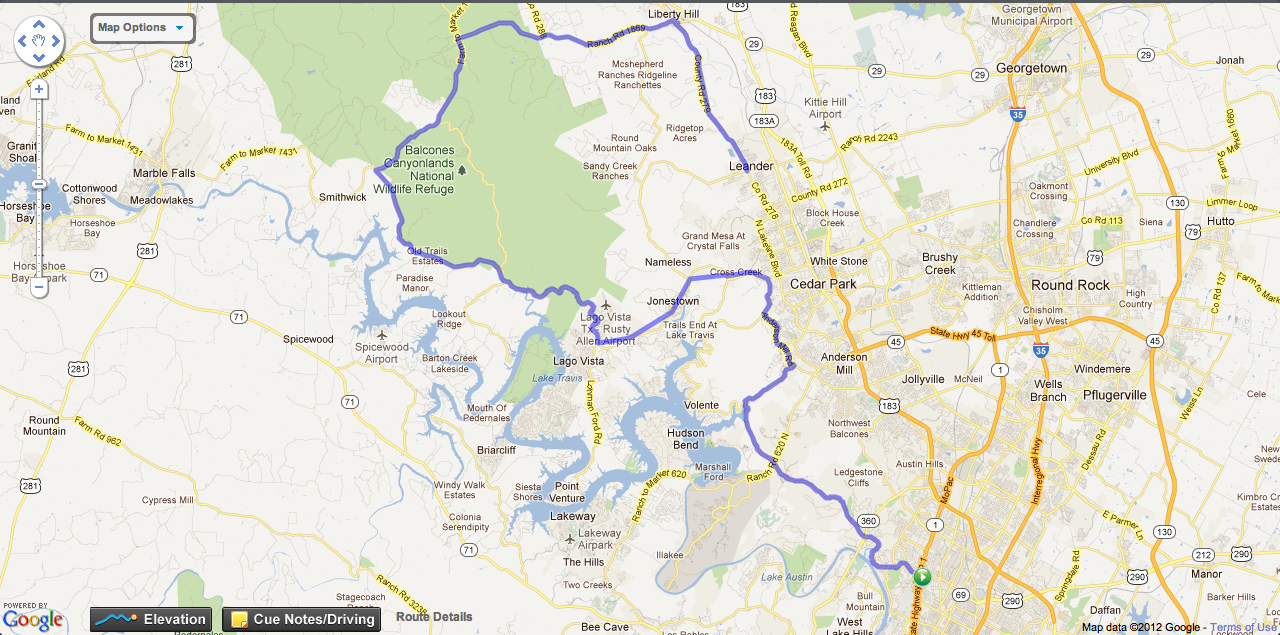
If there were any objective to this trip besides simply getting out there, it's to see the Balcones Canyonlands National Wildlife Refuge. It's the largest expanse of 'green' on my map anywhere near Austin, so I'm drawn to it. Part of my drive takes me along the border and then through the Refuge. It is a different kind of beautiful than I'm used to. Instead of the lush trees and greenery of the East Coast, the trees here seem a little less dense and a little less tall. The ground follows the same 'less lush' feel in the fact that it's dry and light-colored as opposed dark, fertile soil. But, it's still pretty. Wildflowers line most of the roads - purples, reds, pinks, blues, all so pretty. And, getting out of the city means the views are farther reaching, meaning I can finally see large expanses of land again.
When I get tired of the cars behind me making me feel like I need to hurry up, I turn. On the roads with only one lane in each direction, I try to at least go the speed limit while still stealing looks at the scenery. It's a happy reminder of the difference between the joy of driving through gorgeous country versus simply getting through it. There isn't much wildlife, actually, besides a few cows here and there, as well as a few horses. I made a MapMyRide of the drive so that I'd be able to recall exactly where I went.
MapMyRide Map
It isn't till about the road going through the Refuge (the road through the green area in the picture above) that I feel like I can safely snap a few pictures. When there is no car traffic for 10 minutes, I feel like it's safe to slow down a little bit.
Being out here is so peaceful. Me, my car, good music, sunshine, and cool wind. Freedom.
Notice the trees. I don't know what kind they are yet, but they're awesome! Different than the kind back
on the East Coast... Kind of safari-like.
You can see for forever! The flowers in the foreground are a little blurry, but they were so pretty.
It's also on the road going through the Wildlife Refuge that I start feeling nature calling on my bladder. All the water from the coffee shop is catching up to me right on time, about an hour into my drive (I obviously know too much about my the size of my bladder.. hehe, I suppose a side effect of constantly having a water bottle with me). One of the wonderful, terrible things about being out in the middle of nowhere, is that you're out in the middle of nowhere.
I find a decent looking gas station when I get back into civilization... aka Leander, TX. The pit stop turns into kind of a break from driving. After using the restroom and typing up a few notes back in the truck (truck), I notice there's now empty space in the tummy. The Blue Bell ice cream sandwich back inside is calling my name. It's satisfying knowing that this awesome adventure cost $1.50, with tax (plus 1/4 tank of gas... but that's not an immediate cost :P). Eating the ice cream sandwich is an excuse to people watch. I'm surprised when I realize almost everyone at the gas station is getting beer. Either a six pack or two, or a big bag of those extra tall, cold cans. It's Sunday. Hmm. Maybe it's the fact that this is the closest establishment for a long while, which draws in a lot of thirsty people...
Once in Leander, the drive pretty much runs through civilization the whole way. Which, is a neat chance to notice the suburbs! The land is fairly flat, and stone is everywhere. White stone houses, buildings, and retaining walls. Even neighborhood entrances are marked by a big flat-sided stone with the name etched in cursive. I think it's a pretty kind of architecture, and, combined with the weather and the landscape, reminds me of being out West (the West US, not West TX). There are also lots of drainage ditches on the sides of roads. These are easy to notice because they look like big slabs of concrete laid over the land. A mark of being in a dry area is that drainage, when it does rain, becomes a big deal. The sudden introduction of rain to an area with parched earth that can't absorb much water usually means flooding if there aren't well-designed concrete ditches and drainage systems.
I can't wait to get back out there. Maybe next time I'll actually have a chance to get out of my car.
The Hill Country gives me one last treat as I'm heading home and hit the highway. The view in my rearview mirror is a rose/amarillo sunset.
One of my favorites :) (Just replace 'farm' with 'ranch' :)


.JPG)
.JPG)


.JPG)

.JPG)

.JPG)
.JPG)
.JPG)
.JPG)
.JPG)
.jpg)


.JPG)


+-+Version+2.jpg)


.jpg)

.jpg)
.jpg)


.jpg)

.JPG)
.JPG)
.JPG)
.JPG)